
Press release
SkillsFuture Singapore Tightens Course Funding Guidelines and Identifies Skills Trends to Strengthen Workforce Development
27 January 2026
SkillsFuture Singapore (SSG) shared a series of updates aimed at strengthening workforce development and quality of training at the Training and Adult Education (TAE) Conference.
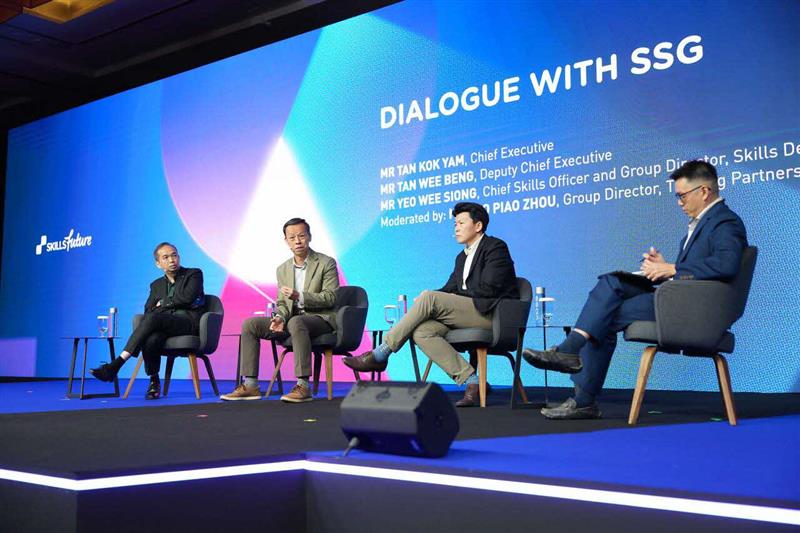
Dialogue session at the Training and Adult Education (TAE) Conference
These include:
-Updates to SSG’s course funding guidelines
-Insights on top skills trends in 2025 to signal in-demand and growing skills.
Guest-of-Honour, Mr David Neo, Acting Minister for Culture, Community and Youth, and Senior Minister of State for Education, graced the event. Themed “Converging Towards CET Excellence”, the TAE conference is an annual event organised by SSG, to engage the TAE sector and its network of partners on labour market trends, and ways to strengthen training quality and relevance. Around 450 industry leaders, training providers, Human Resource professionals, educators, and policymakers attended the event.
Updates to SSG’s Course Funding Guidelines
SSG has refined its course funding framework, to better encourage training providers to engage enterprises and develop industry-relevant training. The tightened guidelines apply from 31 December 2025 onwards, covering courses that seek to develop currently-demanded skills for a person’s current job or profession. Courses that cater to emerging skills (SkillsFuture Series), or that seek to equip a person to take on a substantially different job (e.g. SkillsFuture Career Transition Programme, Institute of Higher Learning Qualifications) are not affected by the change. More details on the revised course funding framework can be found in Factsheet 1.
Top Skills Trends in 2025
Using data science and statistical methods, SSG has identified the top skills in 2025 for various skill clusters. Demand for AI-related skills has increased across industries. For example, within the IT and Data management cluster, the skill of “Generative AI Principles and Applications” has experienced the fastest growth in demand based on jobs posting data. At the same time, there continues to be strong demand by employers for critical core skills such as problem-solving, collaboration and communication. More details on the top skills trends can be found in Factsheet 2.
SSG has extended our methodologies to start analysing the impact of AI on component tasks of jobs. The reason for this is because AI tools, like other software applications, are generally described in terms of the tasks they can perform. Thus, task-level analysis of jobs provides insights on the impact of these AI tools on different jobs. Our analysis found that, given today’s technology, about a quarter of work tasks can be significantly aided by AI, either with existing generic tools, or with some level of workflow and software customisation. For the TAE sector, the implication is that we need to supply training to help Singaporeans use AI well for these tasks. Users can use the new “AI Potential on Tasks” dashboard on the Jobs-Skills Portal to find out more. More resources will also be available in the coming year to help our workforce and enterprises monitor these trends, and identify skills that they need to develop in their workforce.
The jobs-skills insights are developed to help individuals, employers, and training providers navigate the evolving jobs-skills landscape, which is becoming increasingly complex and dynamic. They can be accessed via a range of resources developed by SSG to serve different groups, including the Careers & Skills Passport, Jobs-Skills Portal, MySkillsFuture portal and TalentTrack+.